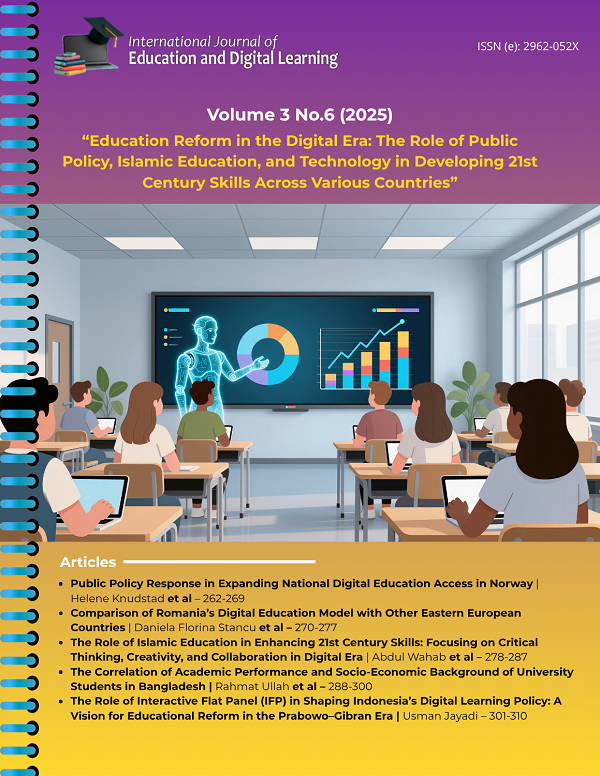
Public Policy Response in Expanding National Digital Education Access in Norway

Published:
2025-08-31Downloads
Abstract
This study analyzes Norway's public policy responses in expanding national access to digital education. Drawing from policy documents, academic literature, and institutional practices, the paper explores how Norway integrates digitalization within its educational system while maintaining its longstanding commitment to equity. The findings are organized into four themes: national strategies, inclusion and accessibility, institutional readiness, and policy effectiveness. Norway has developed comprehensive digital education strategies that embed digital literacy into curricula, enhance teacher competencies, and ensure infrastructure support. Despite significant progress, challenges persist, especially in ensuring equitable access for students with disabilities, refugees, and those in remote areas. Institutional readiness varies, with universities and urban schools leading innovation, while vocational and rural institutions lag. Moreover, evaluation mechanisms often prioritize infrastructure over learning outcomes, leading to a policy-performance gap. The study concludes that while Norway’s approach offers a strong foundation, future success depends on adaptive governance, sustainable investment, and participatory policy-making that centers pedagogy and learner diversity. These insights contribute to broader debates on how advanced welfare states can ensure inclusive, effective, and future-ready digital education.
Keywords:
digital education policy inclusion institutional readinessReferences
Abamosa, J. Y., Hilt, L., & Westrheim, K. (2020). Social inclusion of refugees into higher education in Norway: A critical analysis of Norwegian higher education and integration policies. Policy Futures in Education, 18, 628–647. DOI: https://doi.org/10.1177/1478210319878327
Almås, A. G., & Krumsvik, R. J. (2008). Teaching in technology-rich classrooms: Is there a gap between teachers’ intentions and ICT practices? Research in Comparative and International Education, 3(2), 103–121. DOI: https://doi.org/10.2304/rcie.2008.3.2.103
Andresen, B. B., & van den Brink, K. (2013). Multimedia in education: Adaptive learning and testing. European Commission Report.
Askim, J. (2022). Student financing for social equity in Norway, 1947–2020. DOI: https://doi.org/10.1093/oso/9780192856296.003.0008
Beck, C. W. (2001). Alternative education and home schooling in Norway. Childhood Education, 77, 356–359. DOI: https://doi.org/10.1080/00094056.2001.10521670
Berg, G. A. (2002). Why distance learning? Higher Education Management and Policy, 14(2), 75–87. DOI: https://doi.org/10.5040/9798216193050
Blikstad-Balas, M. (2012). Digital literacy in upper secondary school – What do students use their laptops for during teacher instruction? Nordic Journal of Digital Literacy, 7(2), 81–96. DOI: https://doi.org/10.18261/ISSN1891-943X-2012-02-01
Brevik, L. M., & Blikstad-Balas, M. (2020). Students' experiences with remote teaching during COVID-19 in Norway. Journal of Digital Learning, 5(1), 1–12.
Erstad, O. (2010). Educating the digital generation. Nordic Journal of Digital Literacy, 5(1), 56–71. DOI: https://doi.org/10.18261/ISSN1891-943X-2010-01-05
Erstad, O., & Quale, A. (2009). Digital competence in Norwegian teacher education. In T. Bastiaens et al. (Eds.), Proceedings of World Conference on E-Learning.
Finnvold, J. E. (2006). Access to specialized health care for asthmatic children in Norway: The significance of parents’ educational background and social network. Social Science & Medicine, 63(5), 1316–1327. DOI: https://doi.org/10.1016/j.socscimed.2006.03.045
Fluck, A., et al. (2016). Arguing for digital technology in school education. Technology, Pedagogy and Education, 25(5), 631–651.
Gulbrandsen, M. (2019). Research universities and institutional innovation: The case of Norway. Higher Education Quarterly, 73(4), 456–470.
Hatlevik, O. E., & Christophersen, K. A. (2013). Digital competence at the beginning of upper secondary school. Computers & Education, 63, 240–247. DOI: https://doi.org/10.1016/j.compedu.2012.11.015
Haug, B. S. (2021). The use of digital tools in Norwegian schools during the COVID-19 pandemic. Scandinavian Journal of Educational Research, 65(5), 781–796.
Hilt, L. T. (2016). Equity and technology in Norwegian classrooms. International Journal of Inclusive Education, 20(2), 156–172.
Hodgson, V., & Spours, K. (2006). Modernising professional learning. Teaching in Higher Education, 11(3), 325–338. DOI: https://doi.org/10.1080/13562510600874326
Iversen, L. (2017). Integration and language education in Norwegian immigration policy documents 1980–2016. Apples: Journal of Applied Language Studies, 11, 101–120. DOI: https://doi.org/10.17011/apples/urn.201712104586
Kimogol, S. S., & Sanderson, N. (2024). Accessibility barriers in digital teaching materials for visually impaired students in Norway.
Krumsvik, R. J. (2009). Situated learning and teachers’ digital competence. Education and Information Technologies, 14, 123–138.
Liu, D., & Solheim, M. C. (2023). Tuition fees for international students in Norway: A policy-debate. Beijing International Review of Education.
Livingstone, S. (2012). Critical reflections on the benefits of ICT in education. Oxford Review of Education, 38(1), 9–24. DOI: https://doi.org/10.1080/03054985.2011.577938
Norwegian Ministry of Education and Research. (2020). Digitalisation Strategy for Basic Education 2017–2021.
Pont, B., & Skalde, A. (2013). Education policy outlook in Norway. OECD Publishing.
Røkenes, F. M., & Krumsvik, R. J. (2014). Development of student teachers’ digital competence. Computers & Education, 76, 1–15.
Schmid, R. F., et al. (2009). Technology's impact on student achievement in higher education. Journal of Educational Computing Research, 41(1), 1–23.
Selwyn, N. (2016). Education and Technology: Key Issues and Debates. Bloomsbury Publishing. DOI: https://doi.org/10.5040/9781474235952
Skaar, H., & Hammer, H. (2013). Writing in digital environments: Norwegian adolescents' perspectives. Literacy, 47(3), 123–130.
Solhaug, T. (2011). New Public Management in educational reform in Norway. Policy Futures in Education, 9(2), 267–279. DOI: https://doi.org/10.2304/pfie.2011.9.2.267
Sundqvist, P. (2009). The impact of digital media on English vocabulary development. Language Learning & Technology, 13(2), 36–58. DOI: https://doi.org/10.64152/10125/44414
Tømte, C., & Hatlevik, O. E. (2011). Gender-differences in self-efficacy ICT among Norwegian students. Computers & Education, 56(1), 1–10.
Utdanningsdirektoratet. (2018). Læreplanverket for Kunnskapsløftet 2020.
Vibe, N. (2016). The impact of digital technologies on Norwegian schools. Nordic Studies in Education, 36(2), 67–86.
Voogt, J., Knezek, G., Cox, M., Knezek, D., & ten Brummelhuis, A. (2013). Under which conditions does ICT have a positive effect on teaching and learning? A call to action. Journal of Computer Assisted Learning, 29(1), 4–14. DOI: https://doi.org/10.1111/j.1365-2729.2011.00453.x
Wenaas, L., & Gulbrandsen, M. (2022). Open access in Norwegian universities. PLoS ONE, 17. DOI: https://doi.org/10.1371/journal.pone.0273091
Wilhelmsen, J., & Ørnes, H. (2018). Digital competence in teacher education. Nordic Journal of Digital Literacy, 13(3), 123–138.
Ytreberg, E. (2009). Media use and learning in Norwegian classrooms. Nordicom Review, 30(2), 53–70. DOI: https://doi.org/10.1515/nor-2017-0373
Østerud, S. (2004). Digital literacy and the implications for education. Scandinavian Journal of Educational Research, 48(1), 29–46.
Øystein, J. (2007). ICT in Norwegian education policy. Education Inquiry, 8(4), 243–265.
License
Copyright (c) 2025 Helene Knudstad, Liv Paulsengaard

This work is licensed under a Creative Commons Attribution-ShareAlike 4.0 International License.