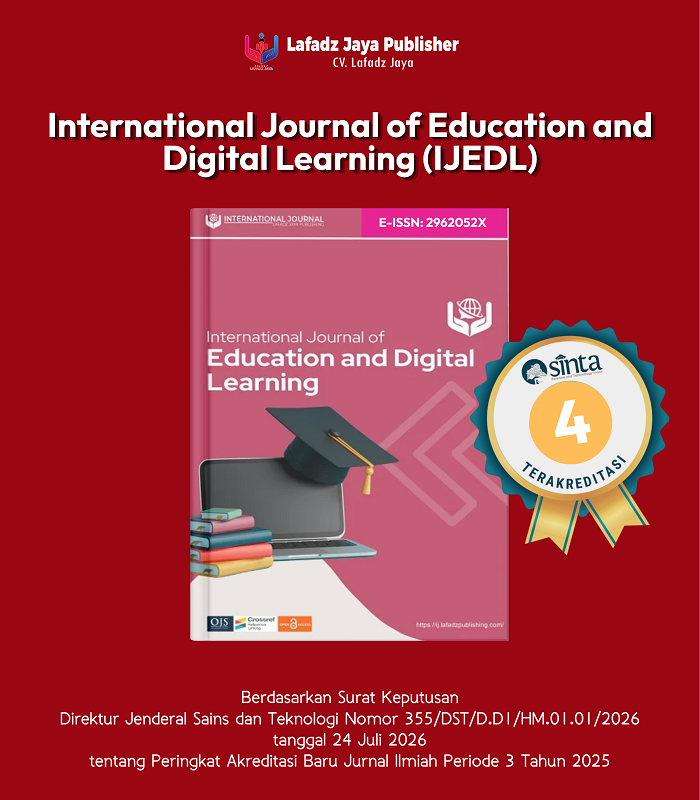

International Journal of Education and Digital Learning (IJEDL) is an international open-access journal in the field of education. IJEDL has held SINTA 4 accreditation from Volume 2 No. 1 (Oct 2023) through Volume 6 No. 2 (Dec 2027) Based on the official decree.


International Journal of Education and Digital Learning (IJEDL) is a globally recognized open-access journal dedicated to advancing educational research through the integration of digital technologies. Published with ISSN (e): 2962-052X, IJEDL provides a platform for original, high-quality articles that contribute to both theoretical and practical aspects of education. The journal welcomes empirical, methodological, and theoretical research in all educational areas, from early childhood development to lifelong learning.
The primary focus of IJEDL includes, but is not limited to, educational technology and digital learning, examining the integration of digital tools and platforms in teaching and learning, including online, blended, and e-learning systems. It also explores curriculum development, instructional design, and the impact of digital technologies on teaching strategies across various educational levels. Additionally, the journal publishes articles on learning theories, cognitive development, and innovative instructional methodologies. Research on assessment and evaluation in digital education, as well as policies and leadership in the adoption of digital tools, is also featured.
IJEDL addresses social and ethical implications of digital education, particularly concerning equity and access, and provides insights into global and comparative education by examining digital learning practices across different international contexts.
Committed to providing free, global, and permanent access to its content, IJEDL ensures that readers worldwide can engage with cutting-edge research. Authors benefit from article promotion, language support, and no space limitations, facilitating rapid publication and long-term preservation. Published six times a year—February, April, June, August, October, and December—IJEDL consistently offers timely and impactful contributions to the field of education and digital learning.
Download Manuscript Template click here!